Picture
Build-a-BUG 5: Yeast Spore Mating Type Detector      Saturday April 6 noon to 4:00 pm

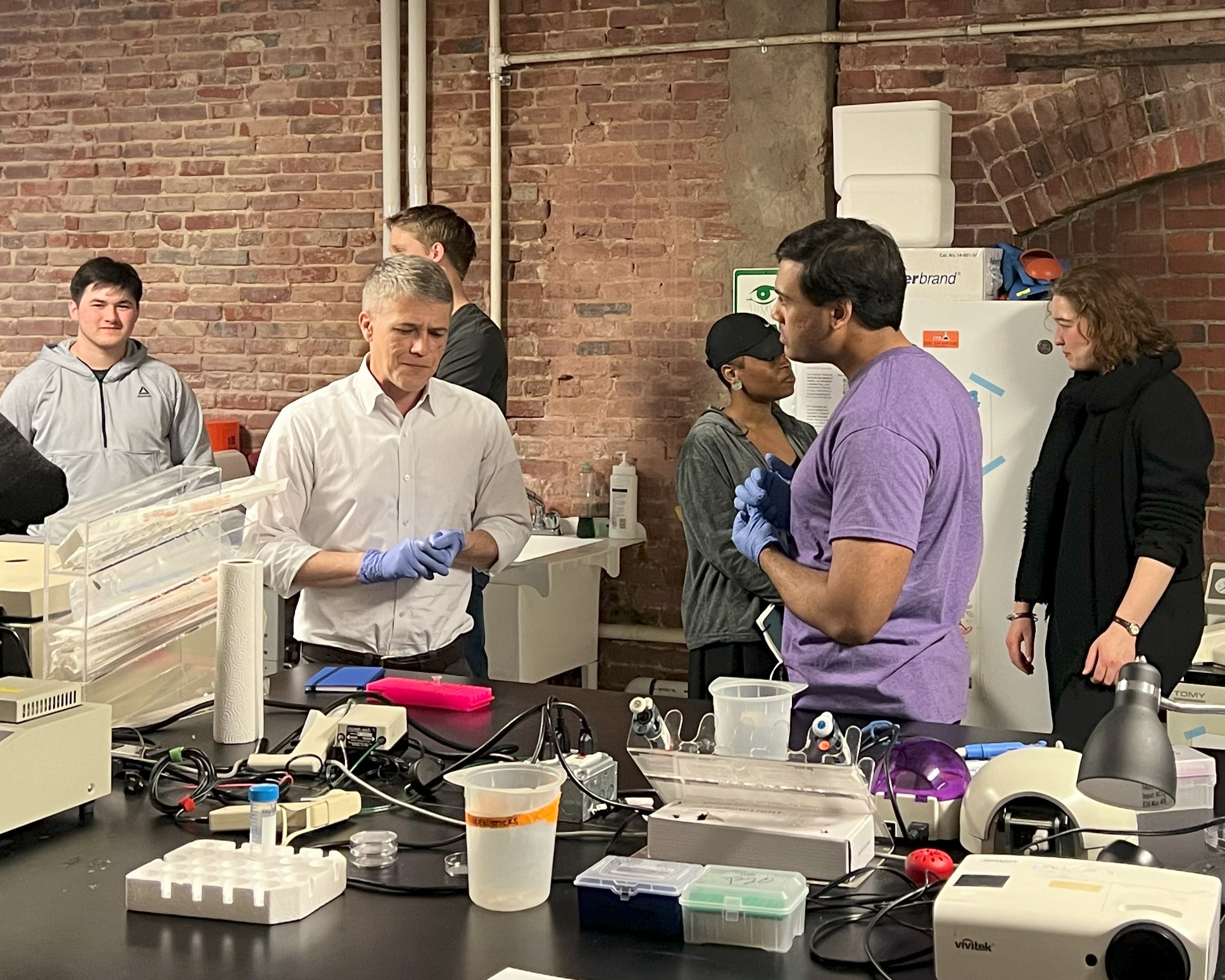
Learn the fundamentals of synthetic biology in eukaryotes!  We will use BioBrick standard biological parts to engineer Saccharomyces cerevisiae, a classic model organism and the yeast commonly used in winemaking,  baking, and brewing.  This yeast can be induced to form spores, which are daughter cells with half the number of chromosomes.  Similar to the sperm and egg cells of  male and female animals, these spores can be one
of two mating types: a  or α.  An a spore can mate with an α spore to form a new yeast cell.  The goal will be  to build a yeast that when sporulated will yield mating type α spores  that fluoresce red.  This project has potential real-world biotechnology applications (e.g. streamlining the identification of spores for downstream mating experiments).

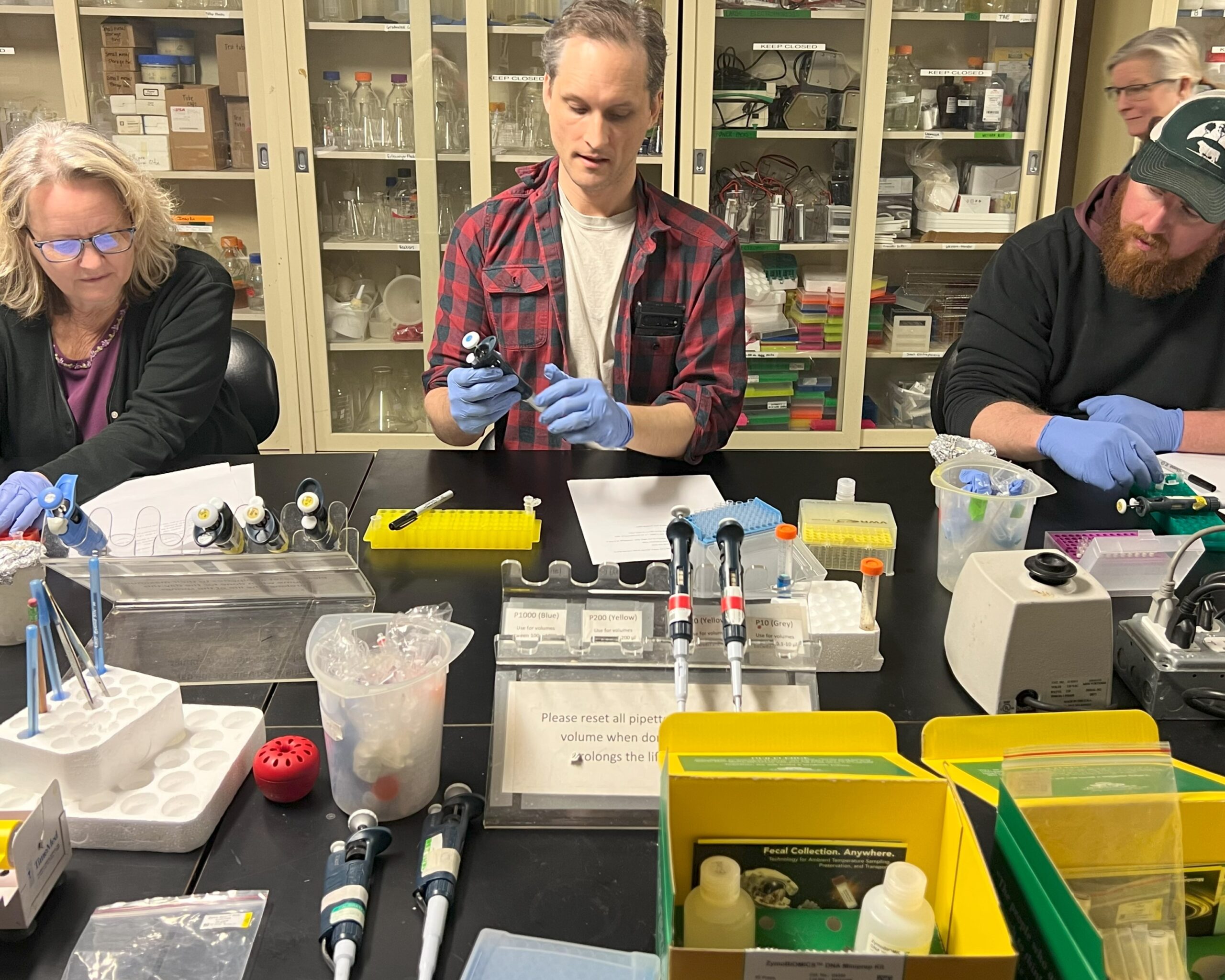
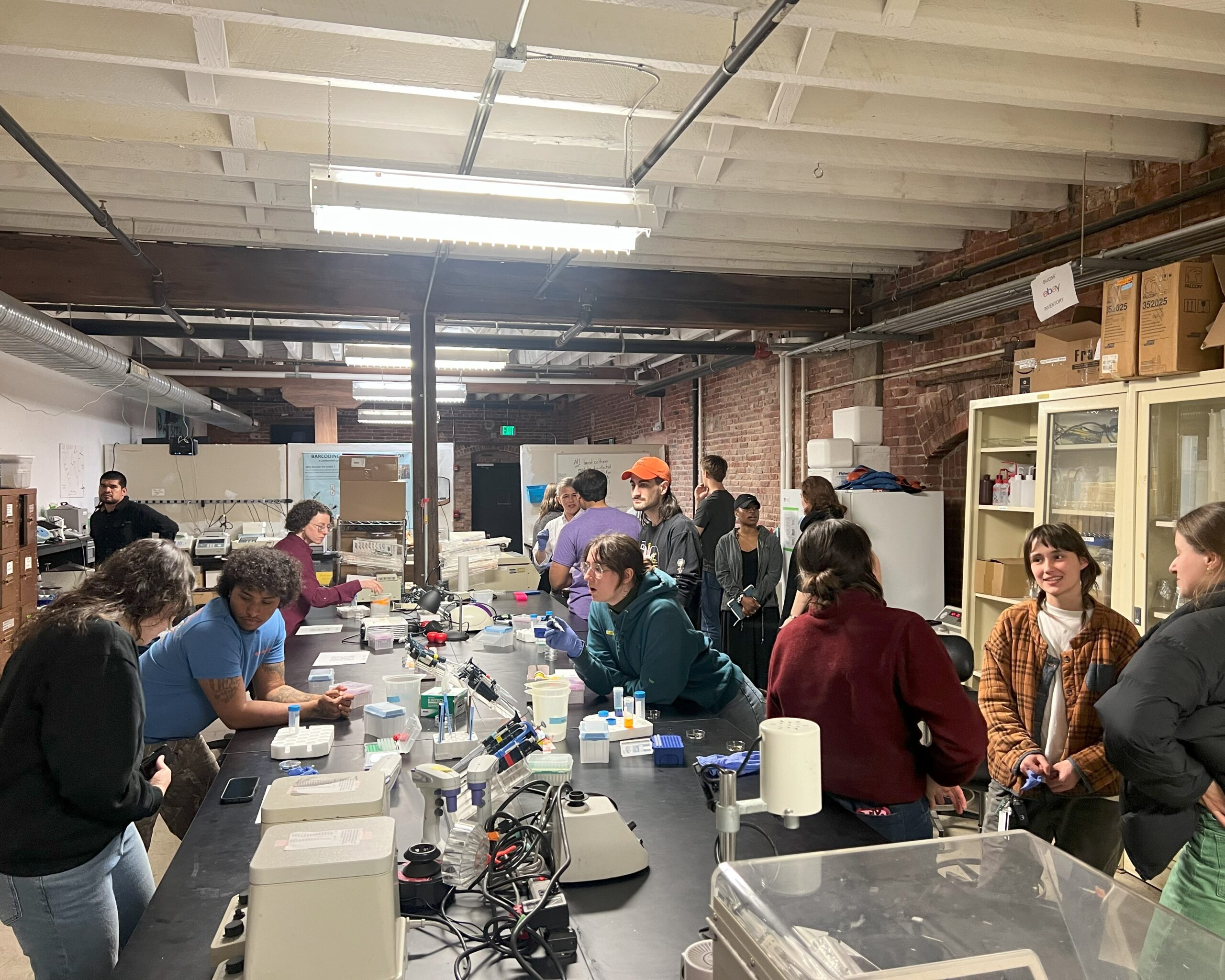
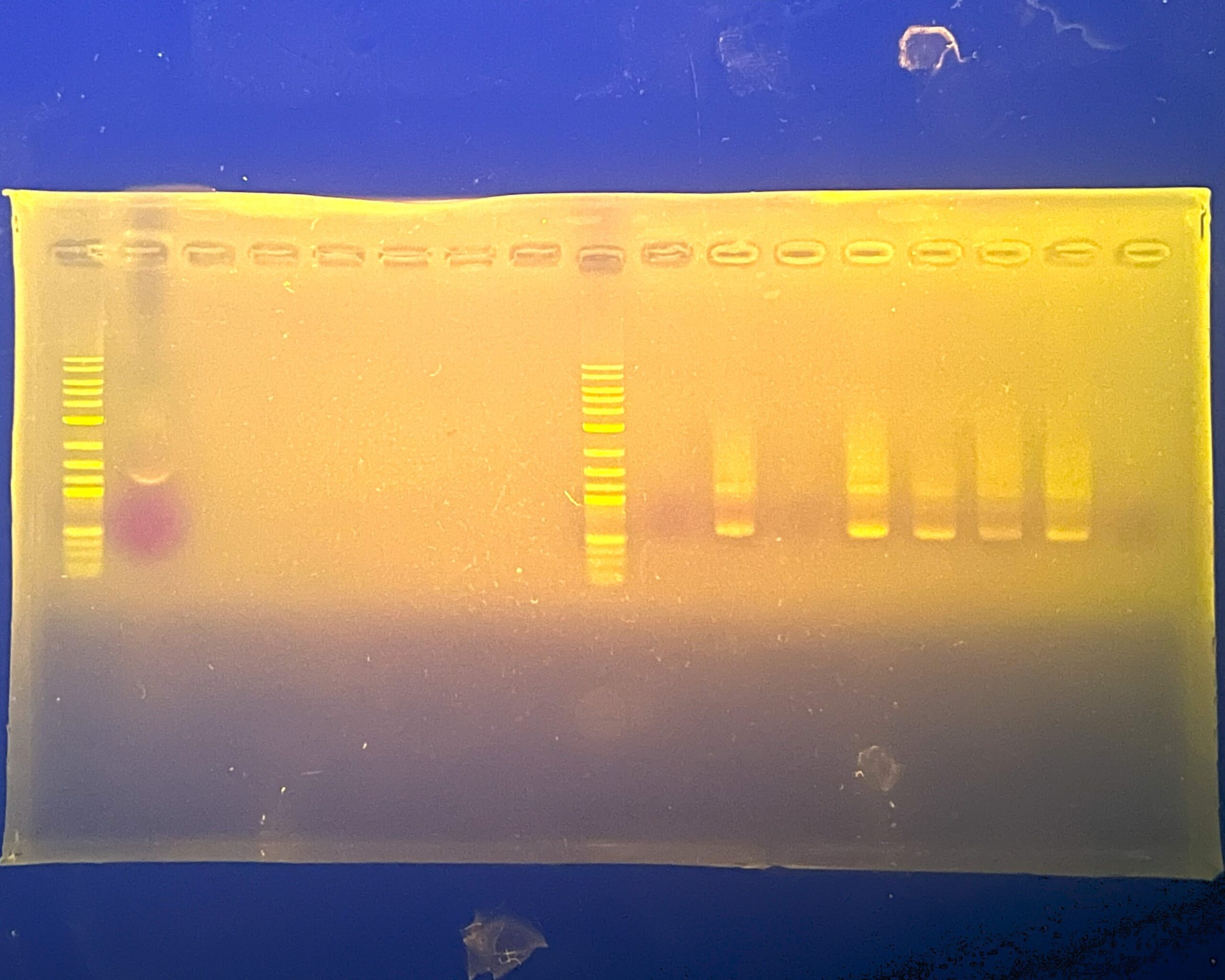
This is the fifth Build-A-BUG workshop in a series of five (or possibly six) on yeast. You will learn more about molecular cloning and continue to hone your basic lab techniques, After successful ligations and E. coli transformations in Session 4, some students have verified their constructs with colony PCR; they then grew up and isolated the pDNA. We will now conclude this Build-a-BUG series by transforming S. cerevisae (yeast) cells with our mating type detector pDNA constructs.

The five sessions are designed to give a good survey of synthetic biology techniques while doing an interesting project.   While we encourage you to take all five sessions, each session can stand on its own.  You do not need to commit to all five sessions to enjoy the experience.  There are no prerequisites, except you must be over 18 years of age (still working on legal stuff to let younger people participate in this activity)

Also, we now have a repository wiki on Open Wet Ware that provides notes, background material, and results for these sessions.

Instructor: Dileep Monie
Cost: Early registration $40/ free for members until April 5.  Starting April 5, cost is $50/ $10 for members 

Please Register HERE!


Picture
Build-a-BUG 4: Yeast Spore Mating Type Detector      Saturday March 23 noon to 4:00 pm

Learn the fundamentals of synthetic biology in eukaryotes!  We will use BioBrick standard biological parts to engineer Saccharomyces cerevisiae, a classic model organism and the yeast commonly used in winemaking,  baking, and brewing.  This yeast can be induced to form spores, which are daughter cells with half the number of chromosomes.  Similar to the sperm and egg cells of  male and female animals, these spores can be one
of two mating types: a  or α.  An a spore can mate with an α spore to form a new yeast cell.  The goal will be  to build a yeast that when sporulated will yield mating type α spores  that fluoresce red.  This project has potential real-world biotechnology applications (e.g. streamlining the identification of spores for downstream mating experiments).

This is the fourth Build-A-BUG workshop in a series of five (or possibly six) on yeast. You will learn more about molecular cloning and continue to hone your basic lab techniques, while building a mating type detector. After troubleshooting an unexpected problem in Session 3, we will actually do ligations (linking DNA) and transformations of competent E. coli cells.

The five (or six) sessions are designed to give a good survey of synthetic biology techniques while doing an interesting project.   While we encourage you to take all five sessions, each session can stand on its own.  You do not need to commit to all five sessions to enjoy the experience.  There are no prerequisites, except you must be over 18 years of age (still working on legal stuff to let younger people participate in this activity)

Also, we now have a repository wiki on Open Wet Ware that provides notes, background material, and results for these sessions.

Instructor: Dileep Monie
Cost: Early registration $40/ free for members until March 8.  Starting March 8, cost is $50/ $10 for members 

Please register HERE


Picture
Build-a-BUG 3: Yeast Spore Mating Type Detector      Saturday March 9 noon to 4:00 pm

Learn the fundamentals of synthetic biology in eukaryotes!  We will use BioBrick standard biological parts to engineer Saccharomyces cerevisiae, a classic model organism and the yeast commonly used in winemaking,  baking, and brewing.  This yeast can be induced to form spores, which are daughter cells with half the number of chromosomes.  Similar to the sperm and egg cells of  male and female animals, these spores can be one
of two mating types: a  or α.  An a spore can mate with an α spore to form a new yeast cell.  The goal will be  to build a yeast that when sporulated will yield mating type α spores  that fluoresce red.  This project has potential real-world biotechnology applications (e.g. streamlining the identification of spores for downstream mating experiments).

This is the third Build-A-BUG workshop in a series of five on yeast. You will learn more about molecular cloning and continue to hone your basic lab techniques, while continuing either your own or somebody else's mating type detector project. This lab will involve ligations (linking DNA) and transformations of competent E. coli cells.

The five sessions are designed to give a good survey of synthetic biology techniques while doing an interesting project.   While we encourage you to take all five sessions, each session can stand on its own.  You do not need to commit to all five sessions to enjoy the experience.  There are no prerequisites, except you must be over 18 years of age (still working on legal stuff to let younger people participate in this activity)

Also, we now have a repository wiki on Open Wet Ware that provides notes, background material, and results for these sessions.

The rest of the series will be on Saturdays   3/23, and 4/6; noon to 4 PM
Instructor: Dileep Monie
Cost: Early registration $40/ free for members until March 8.  Starting March 8, cost is $50/ $10 for members  Please register HERE


Picture
The creative process at BUGSS continues to grow! 

Join us this Thursday 7-9pm and make your own piece of bio-art. Suggested donation is $15 to cover the expense of making each piece. Space is limited so contact us at info@bugssonline.org to reserve your spot.

What will happen this Thursday night you ask? We will begin the evening by discussing any bio-art lab safety practices and thoughts or questions behind our design techniques. In a bio-nut-shell, the image to the left describes the 'painting' process. Think of the petri dish as a ‘canvas’ where bacterial 'paint cells' can converse. One type of cell will ‘speak’, and the other type will ‘listen‘ and it turn ‘respond’ to what is said by turning red. Anywhere you see red in the heart design at the bottom right you know two cells had a successful chat. 

                                        So, what conversation will grow on your petri dish bio-art canvas?


Picture
Tom and I went to the FBI-DIY Bio outreach conference in Walnut Creek last year. It was a really fun forum for learning about the various DIY bio artistic and scientific efforts all over the world. (We could not believe how many artists were calling themselves practitioners of DIY Bio)   Incredibly, this was all funded (plane tickets, meals, and all) by the FBI. The cost was a brief slide presentation of your DIY bio activities.

We were there to announce the forming of a community laboratory in Baltimore, but what to call the thing?  Lucky for us, there was a bio-security workshop that all the conference-goers participated in (some more reluctantly than others) The workshop presented a series of hypothetical situations involving a still-hypothetical-at-the-time community laboratory called BUGSS, so, naturally, we stole the name.

Journalists Hanno Charisius, Richard Friebe, and Sascha Karberg recount
their version of the details of this adventure, admittedly with some ominous overtones, in a recent article in BBC FUTURE.

But what's this all about?  Is it really that scary, or is there a strategy here that makes a lot of sense?  Representatives of the FBI's Weapons of Mass Destruction Directorate will be here to tell us all about it.  Here are their words:

“The Federal Bureau of Investigation’s Weapons of Mass Destruction Directorate is charged with building a cohesive and coordinated approach to incidents involving nuclear, radiological, biological, or chemical weapons—with an overriding focus on prevention. With the rapid development of technology, capabilities and information regarding the biological world, a proactive approach is being taken to address the misuse of biological agents as weapons of mass destruction. Supervisory Special Agent Nathan E. Head, Ph.D, from FBI Headquarters in Washington, D.C. will speak about the FBI’s efforts to address this important issue, along with representatives from the FBI’s Baltimore Field Division.”

Please come on over for a frank discussion of DIY Bio, community laboratories, and bio-security  with the FBI,  You might be surprised at what you hear.  FREE to ALL!

Steve Stowell


Picture
Build-a-BUG 2: Yeast Spore Mating Type Detector      Saturday February 23 noon to 4:00 pm

Learn the fundamentals of synthetic biology in eukaryotes!  We will use BioBrick standard biological parts to engineer Saccharomyces cerevisiae, a classic model organism and the yeast commonly used in winemaking,  baking, and brewing.  This yeast can be induced to form spores, which are daughter cells with half the number of chromosomes.  Similar to the sperm and egg cells of  male and female animals, these spores can be one
of two mating types: a  or α.  An a spore can mate with an α spore to form a new yeast cell.  The goal will be  to build a yeast that when sporulated will yield mating type α spores  that fluoresce red.  This project has potential real-world biotechnology applications (e.g. streamlining the identification of spores for downstream mating experiments).

This is the second Build-A-BUG workshop in a series of five on yeast. 
You will continue to hone your basic lab techniques, including pipetting and centrifugation, while continuing either your own or somebody else's mating type detector project. This lab will involve restriction digests (cutting DNA), agarose gel electrophoresis (visualizing DNA), and gel extractions (recovering DNA fragments).

The five sessions are designed to give a good survey of synthetic biology techniques while doing an interesting project.   While we encourage you to take all five sessions, each session can stand on its own.  You do not need to commit to all five sessions to enjoy the experience.  There are no prerequisites, except you must be over 18 years of age (still working on legal stuff to let younger people participate in this activity)

Also, we now have a repository wiki on Open Wet Ware that provides notes, background material, and results for these sessions.

The rest of the series will be on Saturdays  2/23, 3/9, 3/23, and 4/6; noon to 4 PM
Instructor: Dileep Monie
Cost: $40 per session (+ eventbrite fees)/ free for members  Please register HERE


Picture
Cells are tiny chemical robots hacked together through billions of years of evolution.  Usually, when you want to understand how a robot works, you read its source code.  The closest thing cells have to source, however, is a kind of interpreted byte-code called DNA.  Reading and understanding this code (which is sometimes brilliant, sometimes kludgey, and never commented) is a major task in modern biology.  

Luckily, there is currently way more sequenced DNA than we know what to do with.  Approximately 150 billion bases of DNA have been sequenced as of late 2012, and this volume is expected to double by 2014.    This data, if printed and bound, would run to sixty thousand volumes: clearly, no human being could ever read even 1% of it, much less use it to discover new biological knowledge.    Our only hope for dealing with this deluge is to develop artificial intelligence to help us do science, or even do it for us. This is already happening.  How?

In this workshop we'll explore some fundamental techniques in computational genomics, focusing on the lowly _E. coli_ bacterium.  We'll start from scratch: after a crash course in molecular biology, we'll download an _E. coli_ genome and begin to analyze it with our own code, so that everything we do can be replicated from the comfort of your own basement.  We'll develop algorithms for finding genes and predicting their expression levels, and by the end of the session we'll have added some comments and documentation to the _E. coli_ code base.  We'll be writing code in Python, and all source will be available during the session.  Please BYO Laptop (if you have one)


Some knowledge of Python may be helpful, but there are no prerequisites, except interest. This session is meant to give the coder (or would-be coder) with little experience in bioinformatics a taste of what its about, in a fun way.

This happens on Friday, Feb 15th at 7:00 pm.  We are asking for a donation, whatever you deem appropriate, so that BUGSS can continue to do this kind of thing.   No this is not NPR. (I think they have a 501(C)(3).  We're still working on ours)  This is the BUGSS lab.

Your guide,   Patrick O'Neill,  is a graduate student in the Erill Lab at UMBC, where he applies machine learning and biophysics to the study of gene regulation in bacteria.  He once crashed a supercomputer.
Please RSVP here. 


Picture
Build-a-BUG 1: Yeast Spore Mating Type Detector      Saturday February 9 noon to 4:00 pm

Learn the fundamentals of synthetic biology in eukaryotes!  We will use BioBrick standard biological parts to engineer Saccharomyces cerevisiae, a classic model organism and the yeast commonly used in winemaking,  baking, and brewing.  This yeast can be induced to form spores, which are daughter cells with half the number of chromosomes.  Similar to the sperm and egg cells of  male and female animals, these spores can be one
of two mating types: a  or α.  An a spore can mate with an α spore to form a new yeast cell.  The goal will be  to build a yeast that when sporulated will yield mating type α spores  that fluoresce red.  This project has potential real-world biotechnology applications (e.g. streamlining the identification of spores for downstream mating experiments).

This is the first Build-A-BUG workshop in a series of five on yeast.  You will be introduced to basic lab techniques, including pipetting and centrifugation, and start your own mating type detector project by doing minipreps (DNA isolation), restriction digests (cutting DNA), and agarose gel electrophoresis (visualizing DNA).  Other Build-A-BUG workshops in this series will cover other techniques.

The five sessions are designed to give a good survey of synthetic biology techniques while doing an interesting project.   While we encourage you to take all five sessions, each session can stand on its own.  You do not need to commit to all five sessions to enjoy the experience.  There are no prerequisites, except you must be over 18 years of age (still working on legal stuff to let younger people participate in this activity)

The entire series will be on Saturdays 2/9, 2/23, 3/9, 3/23, and 4/6; noon to 4 PM
Instructor: Dileep Monie
Cost: $40 per session (+ eventbrite fees)/ free for members  Please register HERE


Picture
Join us this (and every) Thursday from 7-9pm and get your Bio-Art and Philosophy on! 

Find out more about what exactly Synthetic Biology is, and how it can be used to construct art. 

From Bio-Couture (http://www.youtube.com/watch?v=WVW-jSdhILs), to Bio-Fiction (http://bio-fiction.com/en/), from ArtScience (http://www.artscienceprize.org/asp/what-is-artscience), to Synthetic Aesthetics (http://www.syntheticaesthetics.org/), and E. Musici (bacteria that are designed to move and create sound: http://2012.igem.org/Team:USC), to creating a Blood Lamp (a statement about our energy consumption: http://www.miket.co.uk/blood_lamp.html). Let’s have some fun and create a space in Baltimore where artists and citizen scientists can collaborate and make works of bio-art and design together.


Picture
BUGSS All Ages Open House Event 02/02/13

Certain fruits, like strawberries, provide an exceptional way to demonstrate basic DNA techniques. At the BUGSS All Ages Open House Event this Saturday February 2nd 2013, kids of all ages will be able to complete a DNA extraction and see first hand that DNA is in the food you eat. Each person will learn the simple method to extract DNA from fruit and why each step is necessary due to the complex organization of DNA in cells. 

This event is open to the public free of charge from 11-3pm.

There will be a MudWatt™ Microbial Fuel Cell (MFC) Kit demonstration, an art station set up for everyone to make bio-inspired crafts, light food and beverages, and more! Stop by with the whole family and see what BUGSS is all about!


    Archives

    April 2013
    March 2013
    February 2013
    January 2013

    Categories

    All